

Digital Marketing vs Performance Marketing: What’s the Difference?
Digital marketing has become essential for businesses that want to reach customers online. But when you start exploring online marketing strategies, you may come across another term: performance marketing.
So, what is the difference between digital marketing and performance marketing?
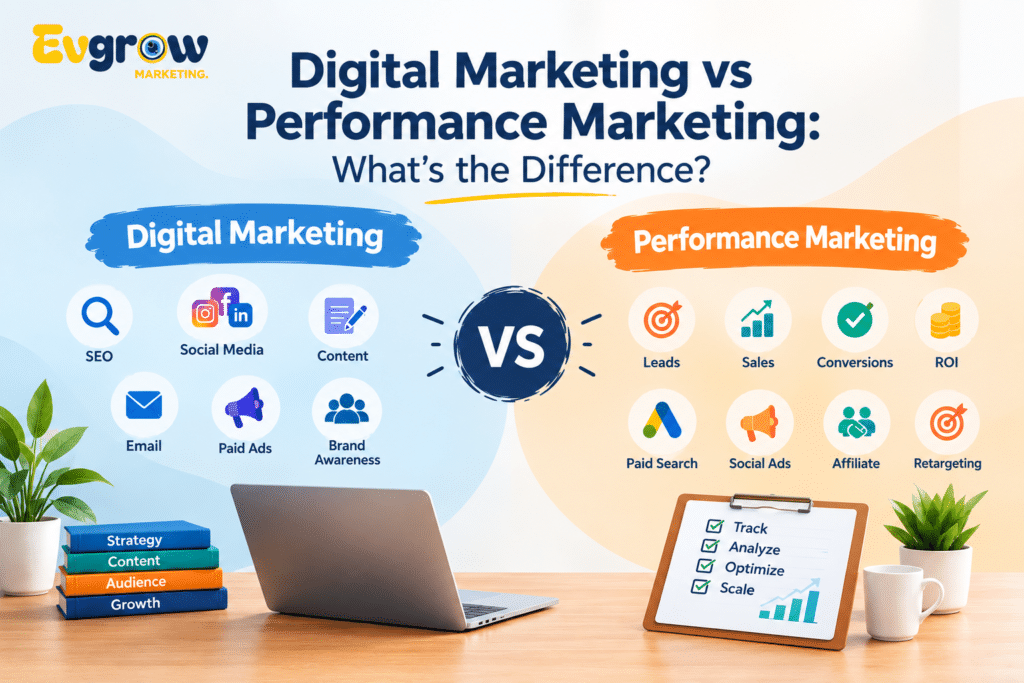
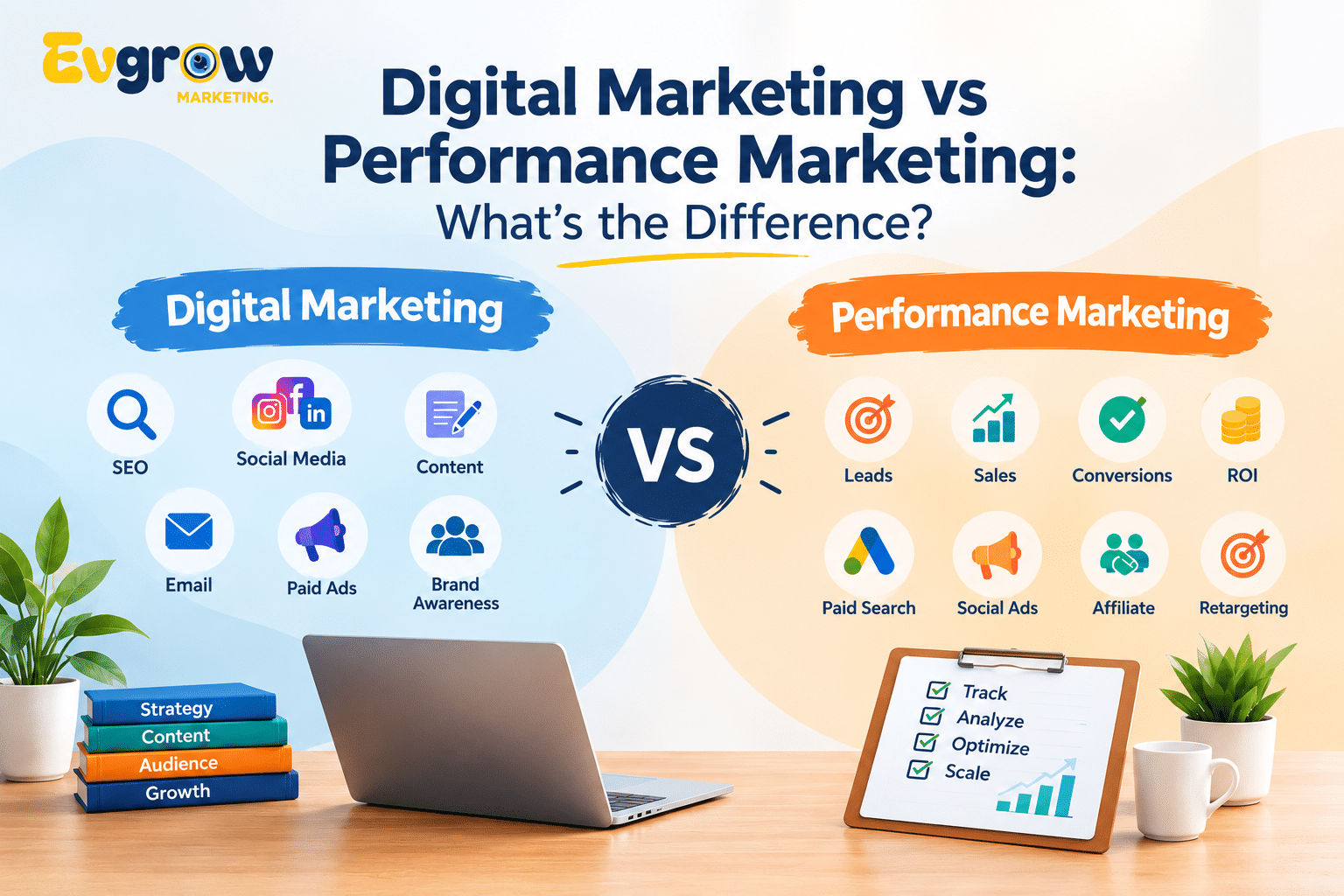
The simplest way to understand it is that digital marketing is a broad field covering many online marketing activities, while performance marketing places stronger emphasis on measurable actions and outcomes. Digital marketing can focus on awareness, engagement, traffic, leads, sales, or customer relationships. Performance marketing typically puts measurable business results such as leads, purchases, or other conversions at the center of campaign optimization.
In this guide, we’ll explain digital marketing vs performance marketing, compare their goals and channels, and show how businesses can use both as part of a broader marketing strategy.
What Is Digital Marketing?
Digital marketing refers to marketing products, services, or brands through digital channels.
It covers a wide range of activities designed to attract, engage, convert, and retain customers online. Depending on the business and campaign objective, digital marketing can include both organic and paid strategies.
Common Digital Marketing Channels
Some of the most common digital marketing channels include:
- Search engine optimization (SEO)
- Search engine marketing (SEM)
- Social media marketing
- Content marketing
- Email marketing
- Influencer marketing
- Display advertising
- Video marketing
- Affiliate marketing
- Online reputation management
For example, a company might publish SEO-focused blog posts to attract organic search traffic while using social media content to build brand awareness and email marketing to nurture existing leads.
Digital marketing is therefore not limited to one platform or one type of result.
Main Goals of Digital Marketing
A digital marketing strategy can have several objectives, including:
- Increasing brand awareness
- Generating website traffic
- Building an online audience
- Generating leads
- Increasing sales
- Improving customer engagement
- Retaining existing customers
The right objective depends on the business, audience, industry, and stage of the customer journey.
What Is Performance Marketing?
Performance marketing is a results-focused approach to marketing where campaigns are planned, measured, and optimized around specific outcomes.
Those outcomes can include actions such as:
- Leads
- Purchases
- App installs
- Sign-ups
- Bookings
- Calls
- Qualified inquiries
- Other defined conversions
For example, a business running paid search ads may track how many users click an advertisement and then submit a lead form. Google Ads, for example, allows advertisers to define conversions and use conversion data for campaign reporting and bidding optimization.
How Performance Marketing Works
A typical performance marketing campaign follows a measurable cycle:
Set a goal → Launch campaign → Track results → Analyze data → Optimize → Scale
Instead of simply asking how many people saw an advertisement, marketers can focus on questions such as:
- How many leads did the campaign generate?
- What was the cost per lead?
- How many sales came from the campaign?
- What was the return on ad spend?
- Which audience generated the most conversions?
- Which creative or landing page performed better?
This data can then be used to improve future campaign decisions.
Common Performance Marketing Channels
Performance marketing can use several digital channels, including:
- Google Ads
- Paid social media advertising
- Affiliate marketing
- Display advertising
- Native advertising
- Retargeting campaigns
- Shopping advertising
- Conversion-focused landing pages
For example, Google Performance Max campaigns are designed around specific goals such as sales, leads, or store visits and use automated optimization across Google’s advertising inventory.
Digital Marketing vs Performance Marketing: Key Differences
Although the two concepts overlap, there are several important differences.
1. Scope
Digital marketing is broader.
It includes many online marketing activities, from SEO and content marketing to social media and paid advertising.
Performance marketing is more focused on measurable outcomes.
It can use some of the same digital channels but evaluates them heavily through defined performance metrics.
2. Primary Goal
Digital marketing may aim to achieve different goals depending on the campaign.
For example:
- Brand awareness
- Engagement
- Website traffic
- Lead generation
- Sales
- Customer retention
Performance marketing generally puts greater emphasis on measurable actions and business outcomes.
3. Measurement
Measurement is important in both approaches, but performance marketing typically puts measurement closer to the center of campaign decision-making.
Digital marketing may track metrics such as:
- Website traffic
- Search rankings
- Social engagement
- Reach
- Impressions
- Leads
- Sales
Performance marketing often emphasizes metrics such as:
- Cost per acquisition (CPA)
- Cost per lead (CPL)
- Conversion rate
- Return on ad spend (ROAS)
- Revenue
- Number of conversions
4. Payment and Budgeting
Some performance marketing models are closely associated with payment based on measurable actions, although the exact pricing model depends on the channel and campaign.
Digital marketing can involve many different cost structures.
For example, SEO requires investment in content and optimization, while paid advertising can use CPC, CPM, CPA, or other bidding and pricing models.
Google Ads, for instance, supports different bidding approaches depending on the campaign and goal.
5. Time Horizon
Digital marketing can support both short-term and long-term objectives.
For example, SEO and content marketing may be designed to build sustainable organic visibility over time, while paid advertising can generate traffic or leads more quickly.
Performance marketing is often closely associated with campaigns where marketers can quickly measure results, test variables, and make optimization decisions.
6. Optimization
Optimization is important across digital marketing.
However, performance marketing typically has a strong emphasis on continuously improving measurable outcomes.
A marketer may test:
- Ad copy
- Headlines
- Images
- Videos
- Audiences
- Keywords
- Landing pages
- Offers
- Calls to action
The results can then inform the next round of campaign optimization.
Digital Marketing vs Performance Marketing: Comparison Table
| Factor | Digital Marketing | Performance Marketing |
|---|---|---|
| Scope | Broad | More outcome-focused |
| Main focus | Online marketing as a whole | Measurable actions and outcomes |
| Goals | Awareness, traffic, engagement, leads, sales, retention | Leads, sales, conversions, revenue and other defined actions |
| Channels | SEO, social media, content, email, paid ads and more | Paid search, paid social, affiliate, display and other measurable channels |
| Measurement | Multiple marketing metrics | Strong emphasis on conversion and financial metrics |
| Optimization | Ongoing | Highly focused on measurable campaign performance |
| Time horizon | Short- and long-term | Often focused on measurable campaign outcomes |
| Example | SEO content campaign | Paid campaign optimized for qualified leads |
Examples of Digital Marketing and Performance Marketing
Understanding the difference becomes easier with examples.
Example 1: SEO Blog Strategy
A company publishes helpful blog posts targeting relevant search queries.
The objective could be to:
- Increase organic visibility
- Educate potential customers
- Build authority
- Generate website traffic
- Support future conversions
This is digital marketing.
Example 2: Google Ads Lead Campaign
The same company launches Google Ads with the goal of generating leads.
The campaign tracks conversions and evaluates metrics such as cost per lead and conversion rate.
This is an example of performance-focused digital advertising.
Google Search campaigns can be used to reach people actively searching for products or services, while campaign goals can include sales and leads.
Example 3: Social Media Brand Campaign
A company publishes Instagram and Facebook content designed to increase awareness and engagement.
The campaign may track:
- Reach
- Impressions
- Engagement
- Follower growth
- Video views
This can form part of a broader digital marketing strategy.
Example 4: Retargeting Campaign
An online store shows advertisements to people who previously visited its website and encourages them to return and complete a purchase.
The campaign can be evaluated through:
- Click-through rate
- Conversion rate
- Cost per acquisition
- Revenue
- ROAS
This is a common example of performance-focused marketing.
Benefits of Digital Marketing
Builds Brand Awareness
Digital marketing gives businesses multiple ways to introduce their brand to potential customers.
Content, social media, video, SEO, email, and advertising can all contribute to visibility throughout the customer journey.
Supports Long-Term Growth
Some digital marketing activities, such as SEO and content marketing, can help businesses build an ongoing online presence.
A useful article or optimized webpage may continue attracting relevant visitors after its initial publication.
Reaches Customers Across Multiple Channels
Customers use different digital platforms at different stages of their buying journey.
A broader digital marketing strategy allows businesses to communicate through channels that fit their audience and objectives.
Benefits of Performance Marketing
Focuses on Measurable Results
Performance marketing gives marketers a clear framework for connecting campaigns with measurable actions.
Instead of focusing only on exposure, businesses can evaluate what happens after someone interacts with a campaign.
Enables Data-Driven Optimization
Campaign data can reveal which audiences, advertisements, keywords, or offers are generating results.
Marketers can use these insights to adjust campaigns and allocate budgets based on performance.
Makes Campaign Performance Easier to Track
When conversion tracking is correctly configured, marketers can connect campaigns with defined actions such as purchases, leads, or sign-ups.
Modern advertising platforms also provide automated optimization tools. For example, Google describes Performance Max as a goal-based campaign type that uses AI and automated bidding to optimize toward conversion goals across Google’s advertising inventory.
Key takeaway: Performance marketing is not simply “another name” for digital marketing. It is better understood as a results-oriented approach that can operate within the broader digital marketing ecosystem.
Can Digital Marketing and Performance Marketing Work Together?
Absolutely.
In many cases, businesses do not need to choose between digital marketing and performance marketing.
They can use both.
For example, an e-commerce business could build a complete digital marketing strategy that includes:
- SEO for organic visibility
- Social media for engagement
- Content marketing for education
- Email marketing for customer retention
- Paid advertising for customer acquisition
- Performance tracking for measurable conversions
This creates a more connected marketing strategy.
Brand-building activities can help create demand, while performance-focused campaigns can help capture and convert that demand. Google has also discussed applying performance measurement across different stages of the customer journey rather than treating brand-building and acquisition as completely separate activities.
Which Marketing Approach Should Your Business Use?
The answer depends on your business objectives.
Consider broader digital marketing activities when your goals include:
- Building brand awareness
- Increasing organic visibility
- Growing an online audience
- Educating customers
- Developing long-term customer relationships
- Supporting multiple stages of the customer journey
Consider a performance-focused strategy when your priorities include:
- Generating leads
- Increasing online sales
- Driving registrations
- Getting bookings
- Tracking customer acquisition costs
- Optimizing campaigns around conversions
For many businesses, the practical approach is not digital marketing vs performance marketing, but rather digital marketing with performance measurement where appropriate.
The right combination depends on your audience, budget, sales cycle, business model, and marketing objectives.
Frequently Asked Questions
Is performance marketing part of digital marketing?
Generally, yes. Performance marketing commonly operates through digital channels and can be considered a results-focused approach within the broader digital marketing landscape.
Is performance marketing better than digital marketing?
They are not directly interchangeable concepts. Digital marketing describes a broad range of online marketing activities, while performance marketing emphasizes measurable outcomes. The appropriate approach depends on the business objective.
What are examples of performance marketing?
Examples include conversion-focused Google Ads campaigns, paid social campaigns, affiliate marketing, retargeting, and other campaigns where measurable actions such as leads, purchases, or sign-ups are central to evaluation.
What is the main difference between digital and performance marketing?
The main difference is scope and focus. Digital marketing covers a broad range of online marketing activities, while performance marketing focuses more heavily on measurable actions, conversions, and business outcomes.
Can a business use both digital marketing and performance marketing?
Yes. A business can use SEO, content, social media, email, and other digital marketing channels while also running performance-focused campaigns designed to generate measurable leads, sales, or conversions.
Conclusion
Understanding digital marketing vs performance marketing becomes much easier when you look at their scope and objectives. Digital marketing is the broader field covering activities such as SEO, content marketing, social media, email, and online advertising. Performance marketing focuses more strongly on measurable actions and outcomes such as leads, sales, conversions, and acquisition costs.
Rather than treating them as competing strategies, businesses can use both strategically. Digital marketing can help build visibility and relationships, while performance-focused campaigns can help measure and optimize specific business outcomes.
If you want to build a stronger online presence, start by defining your business goal, identifying your audience, and selecting the channels that support that goal.
Ready to take your business online? Choosing the right digital marketing strategy is just the beginning. A professional website, effective digital marketing, performance-focused campaigns, and engaging content can work together to create a stronger online presence and support sustainable business growth.
Have questions about digital marketing or performance marketing? Drop them in the comments below or reach out to the EVGROW Marketing team. We would love to understand your business goals and help you explore the right digital strategy.