
Table of Contents
Explore the 12 key benefits of digital marketing for every business
1. Introduction
Imagine running a business with quality products, excellent services and competitive prices, but potential customers are unable to find you online.
Today, many customers use search engines, social media platforms and websites to discover products, compare services, read reviews and make purchasing decisions. If your business does not have a strong online presence, you may miss opportunities to connect with these potential customers.
This is where digital marketing becomes important.
Digital marketing allows businesses to promote their products and services through online channels such as Google, Facebook, Instagram, websites, email and other digital platforms. It helps companies reach relevant audiences, communicate with customers, generate leads and build long-term relationships.
Whether you operate a small local shop, a startup, an e-commerce store or an established company, digital marketing can support your business growth when it is planned and implemented effectively.
In this guide, we will explore why digital marketing is important for every business, its major benefits, different marketing channels and practical ways to develop a successful strategy.
2. What Is Digital Marketing?
Digital marketing refers to promoting products, services or brands through digital platforms and online communication channels.
Unlike traditional marketing methods such as newspaper advertisements, banners, flyers and television commercials, digital marketing uses internet-based platforms to connect businesses with their target audiences.
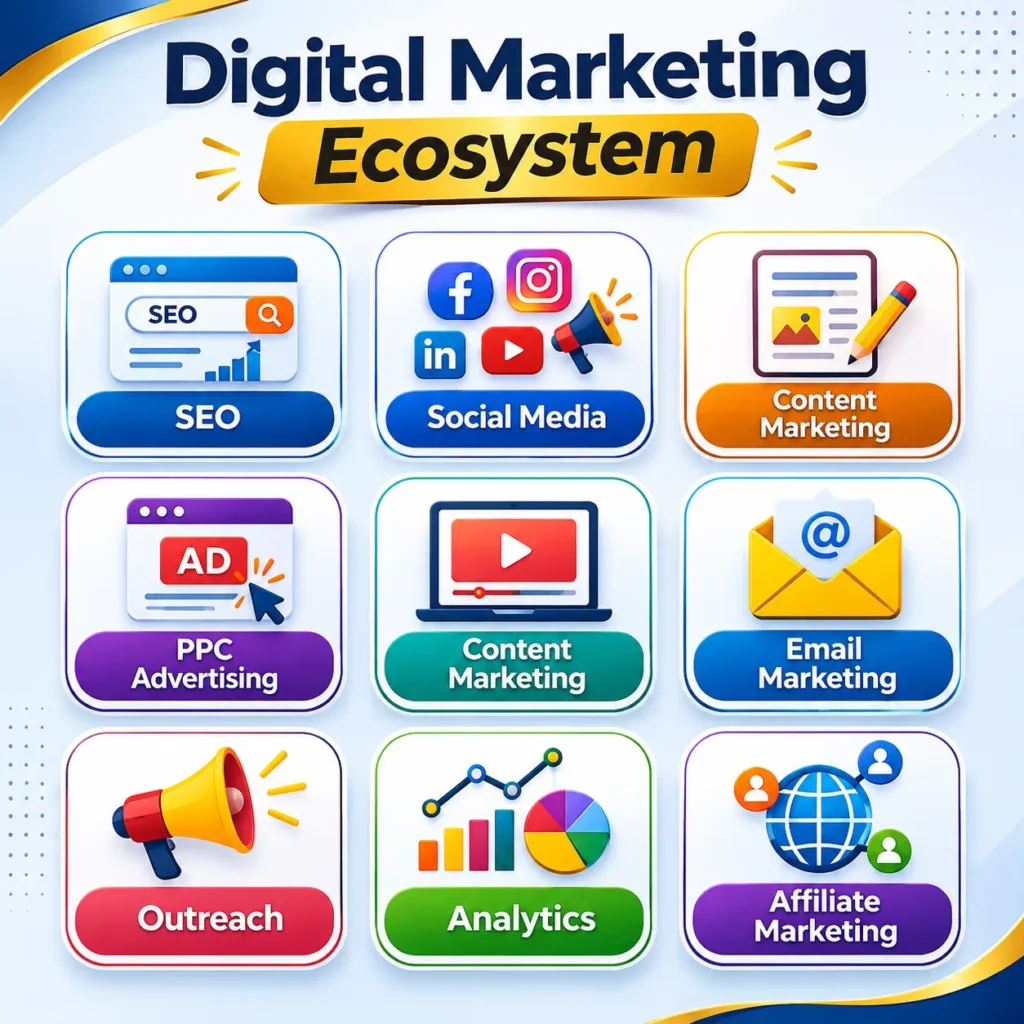
Some common digital marketing channels include:
- Search Engine Optimization (SEO): Improving a website’s visibility in organic search results.
- Social Media Marketing: Promoting a brand through platforms such as Facebook, Instagram and LinkedIn.
- Google Ads: Reaching people through paid advertisements on Google’s advertising network.
- Meta Ads: Promoting products and services through Facebook and Instagram advertising.
- Content Marketing: Publishing useful articles, videos, guides and other content.
- Email Marketing: Communicating with potential and existing customers through email.
- Local SEO: Improving visibility for relevant location-based searches.
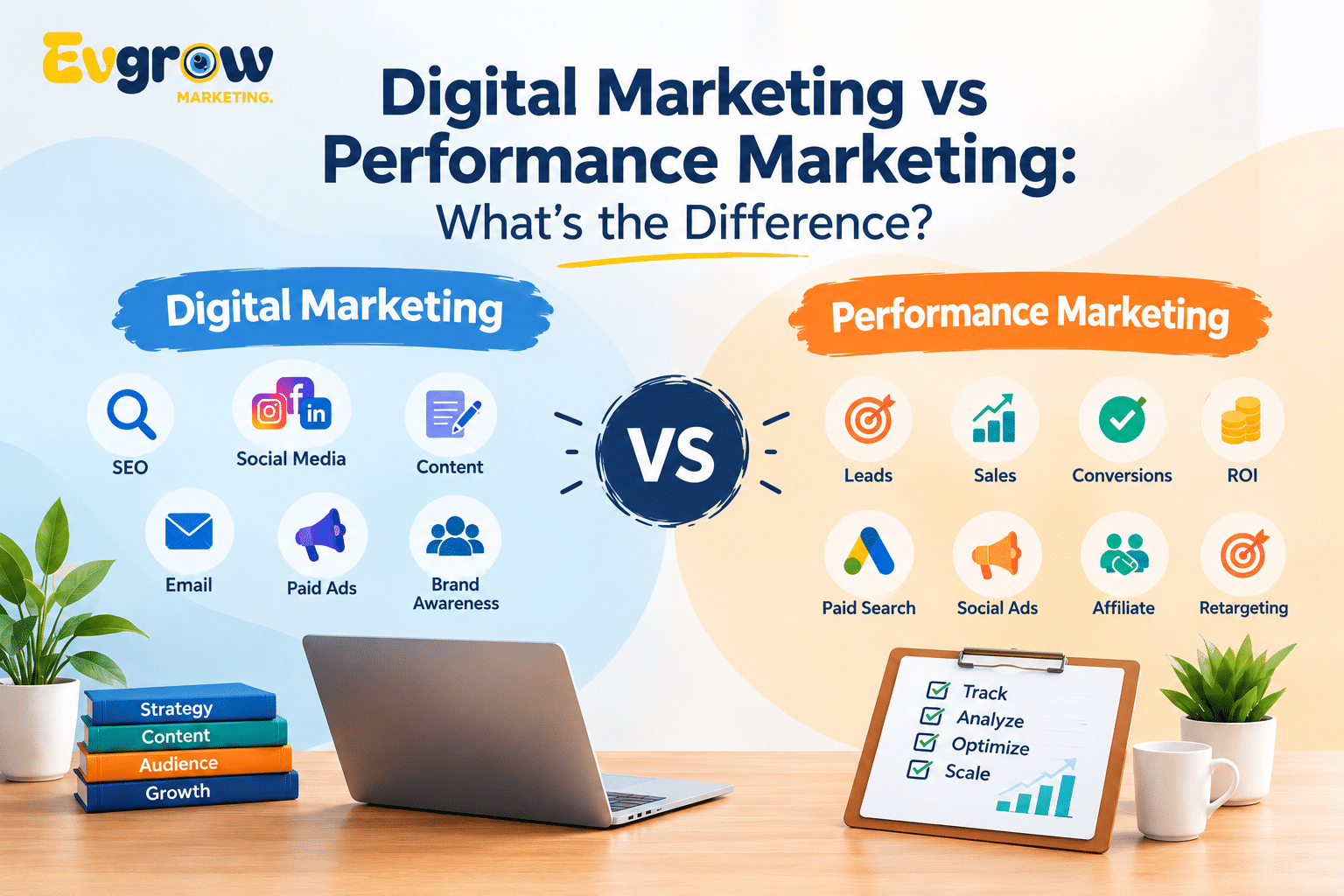
- Performance Marketing: Measuring and optimizing marketing campaigns around specific business outcomes.
These channels can work independently or together, depending on the company’s goals, audience and budget.
3. Why Is Digital Marketing Important for Every Business?
Digital marketing is important because customer behaviour has changed. People increasingly use digital platforms to research businesses, discover new products and evaluate their purchasing options.
Businesses need to be present where their potential customers spend time and search for solutions.
For example, imagine someone searching for an interior designer in Kolkata. They may check Google results, visit business websites, explore Instagram portfolios and read customer reviews before contacting a company.
A business with a professional website, relevant online content and a well-maintained digital presence has more opportunities to become part of that customer’s decision-making process.
Digital marketing also helps businesses:
- Reach relevant audiences beyond their immediate location.
- Build awareness and establish brand credibility.
- Generate inquiries and potential customers.
- Promote products and services through different channels.
- Understand customer interests and behaviour.
- Measure campaign performance.
- Improve marketing decisions using available data.
However, digital marketing does not guarantee immediate sales or business growth. Results depend on factors such as strategy, competition, budget, customer demand, product quality and campaign execution.
4. 12 Key Benefits of Digital Marketing for Businesses
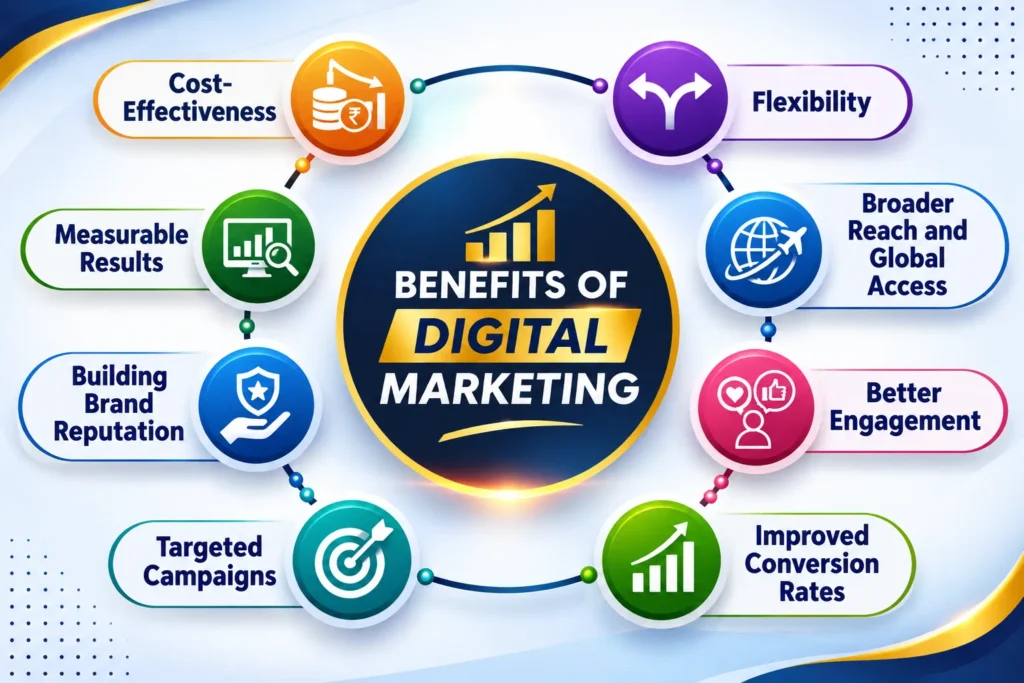
4.1 Increase Brand Awareness
Before customers purchase a product or service, they need to know that your business exists.
Digital marketing helps businesses introduce their brands to relevant audiences through search engines, social media, online advertisements and valuable content.
For example, a new clothing brand can use Instagram Reels, product photography and targeted advertisements to introduce its collections to potential customers.
Consistent and relevant communication can help people recognize and remember your brand.
4.2 Reach Your Target Audience
Traditional advertising often reaches a broad audience, including people who may not be interested in your products or services.
Digital marketing provides opportunities to reach more relevant audiences.
For example:
- A restaurant can promote offers to people in nearby areas.
- A real estate company can reach people interested in buying property.
- An educational institute can promote courses to students and parents.
- A B2B company can connect with business owners and decision-makers.
The right audience strategy depends on your industry, location, customer profile and campaign objectives.
4.3 Generate More Business Leads
Lead generation is one of the most important objectives of digital marketing.
Businesses can use Google Ads, Meta Ads, SEO, landing pages and content marketing to encourage potential customers to submit inquiries.
For example, a website development company can run a Google Search campaign targeting people searching for website design services.
Interested visitors can then contact the company through a form, phone call or WhatsApp.
The goal should not simply be to generate more leads. Businesses should focus on attracting relevant leads who have a genuine interest in their products or services.
4.4 Improve Website Traffic
A business website can act as a central destination where potential customers learn about products, services, pricing, company information and contact details.
Digital marketing helps bring relevant visitors to that website.
Different channels contribute in different ways:
- SEO attracts organic visitors from search engines.
- Google Ads reaches people searching for relevant products and services.
- Social media marketing directs interested audiences to website pages.
- Email marketing brings subscribers back to useful content and offers.
More website traffic does not automatically mean more sales. The visitors should be relevant, and the website should provide a clear and useful experience.
4.5 Make Marketing More Measurable
One major advantage of digital marketing is the ability to track many aspects of campaign performance.
Businesses can monitor metrics such as:
- Website visitors
- Impressions and reach
- Click-through rate (CTR)
- Cost per click (CPC)
- Cost per lead (CPL)
- Conversion rate
- Customer acquisition cost (CAC)
- Return on ad spend (ROAS)
For example, if a business spends money on a lead generation campaign, it can analyse how many inquiries were received, how much each lead cost and how many leads became customers.
This information helps marketers identify areas for improvement.
4.6 Build Customer Trust and Credibility
Customers often want to understand a business before making a purchase.
A professional website, useful social media content, authentic customer reviews, clear contact information and consistent communication can help establish credibility.
For example, an interior design company can publish completed project photographs, design ideas, customer testimonials and informative videos.
This gives potential customers a better understanding of the company’s work and approach.
Businesses should always use genuine testimonials and accurate information rather than misleading claims.
4.7 Compete With Larger Businesses
Small businesses may not have the same marketing resources as large companies. However, digital marketing provides opportunities to compete within specific markets and customer segments.
A local business can focus on a particular location, service category or customer need rather than trying to reach everyone.
For example, a small bakery can create location-focused content, optimize its Google Business Profile, share product photographs and run advertisements targeting nearby customers.
A focused strategy can help a smaller business become more visible to the right audience.
4.8 Promote Products and Services Faster
Digital platforms allow businesses to communicate new product launches, seasonal offers, service updates and promotional campaigns.
An e-commerce company, for example, can use product advertisements, social media posts and email campaigns to introduce a new collection.
Businesses can also test different messages and creative formats to understand which ones attract more attention.
4.9 Improve Customer Engagement
Digital marketing creates opportunities for businesses to communicate with customers beyond the point of purchase.
Customers can interact with brands through comments, messages, emails, reviews and online communities.
Businesses can use these interactions to:
- Answer customer questions.
- Share useful information.
- Collect feedback.
- Announce updates.
- Address customer concerns.
- Maintain relationships with existing customers.
Regular and helpful communication can support customer satisfaction and long-term relationships.
4.10 Support Local Business Growth
Local businesses depend heavily on customers in their surrounding areas.
Local SEO, Google Business Profile, location-focused website content and targeted social media campaigns can help these businesses improve their local online visibility.
For example, a salon in Kolkata may want to appear when nearby customers search for relevant salon services.
A complete and accurate Google Business Profile can help eligible local businesses appear across Google Search and Maps. It also provides customers with useful information such as business hours, contact details and directions.
4.11 Create Opportunities for Customer Retention
Digital marketing is not only about attracting new customers. It can also help businesses maintain relationships with existing customers.
Email newsletters, product updates, useful social media content and personalized communication can encourage customers to stay connected with a brand.
For example, an online clothing store can share new arrivals with customers who have opted in to receive promotional emails.
The objective is to provide relevant value and maintain a positive customer experience, not simply send repeated promotional messages.
4.12 Scale Marketing Based on Business Goals
Digital marketing campaigns can be adjusted according to business objectives, audience response and available resources.
A company may begin with local SEO and social media marketing, then introduce paid advertising when it is ready to reach a wider audience.
Businesses can also increase or reduce campaign budgets based on performance and operational capacity.
This flexibility makes digital marketing useful for businesses at different stages of development.
5. Major Types of Digital Marketing Every Business Should Know
There is no single digital marketing channel that works equally well for every business. Understanding the different options helps companies select the right combination.
| Digital Marketing Channel | Main Purpose | Suitable For |
| SEO | Improve organic search visibility | Businesses seeking long-term organic traffic |
| Social Media Marketing | Build awareness and engagement | Consumer brands, local businesses and startups |
| Google Ads | Reach people actively searching | Service businesses and product sellers |
| Meta Ads | Generate awareness, leads and sales | E-commerce, local businesses and consumer brands |
| Content Marketing | Educate and attract audiences | B2B, professional services and growing brands |
| Email Marketing | Nurture and retain customers | E-commerce and businesses with subscriber lists |
| Local SEO | Improve location-based visibility | Shops, restaurants, clinics and local services |
| Performance Marketing | Optimize measurable outcomes | Businesses running measurable campaigns |
Search Engine Optimization (SEO)
SEO helps websites improve their visibility in organic search results.
It includes activities such as keyword research, technical optimization, content development, internal linking and website improvements.
SEO is generally a long-term strategy. Businesses should not expect guaranteed rankings or instant results.
Social Media Marketing
Social media marketing helps businesses communicate with audiences through platforms such as Facebook, Instagram and LinkedIn.
It can include content creation, reels, educational posts, community engagement and paid promotions.
Google Ads and Meta Ads
Google Ads can help businesses reach people searching for relevant products and services.
Meta Ads can help businesses reach selected audiences through Facebook and Instagram placements.
Both platforms offer different campaign options, and the right choice depends on the customer journey and campaign objective.
Content Marketing
Content marketing involves creating useful and relevant content to attract and educate potential customers.
Examples include:
- Blog articles
- Educational videos
- Case studies
- Guides and tutorials
- Infographics
- Industry insights
Useful content can support brand awareness, organic visibility and customer trust.
6. Digital Marketing vs Traditional Marketing
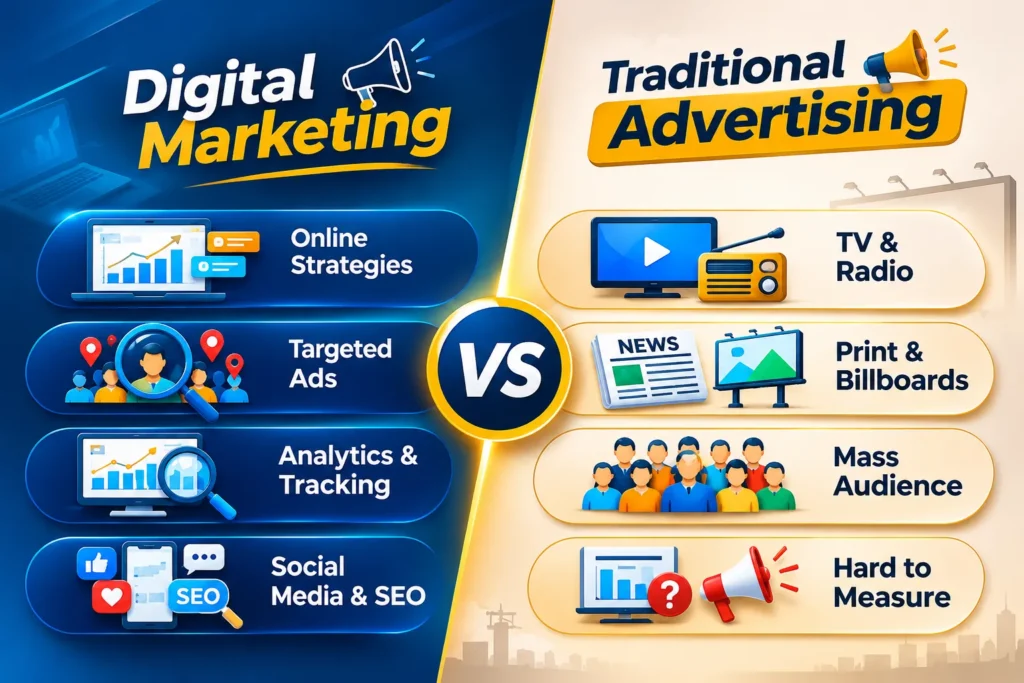
Traditional marketing and digital marketing both have a role in business promotion. The right approach depends on the audience, objective and available budget.
| Comparison | Digital Marketing | Traditional Marketing |
| Channels | Websites, search engines, social media and email | Newspapers, television, radio and print |
| Audience | Can target specific audience groups | Often reaches broader audiences |
| Measurement | Many digital metrics can be tracked | Measurement may be less direct |
| Communication | Can support two-way interaction | Often primarily one-way |
| Flexibility | Campaigns can be adjusted during delivery | Changes may require additional production |
| Reach | Can reach local or international audiences | Depends on the selected medium |
| Cost | Flexible budget options are available | Costs vary by media and placement |
Digital marketing is not always cheaper than traditional marketing, and traditional marketing is not automatically ineffective.
Many businesses can benefit from combining both approaches.
7. How Digital Marketing Helps Different Types of Businesses
Different industries have different marketing requirements. Here are some practical examples.
Small Businesses and Local Shops
Local businesses can use Google Business Profile, local SEO, social media and location-based advertisements to reach nearby customers.
Restaurants and Cafes
Restaurants can share food photography, menu highlights, customer experiences, short-form videos and location-focused promotions.
Real Estate Companies
Real estate businesses can use property landing pages, project videos, Google Ads, Meta Ads and lead generation campaigns to connect with prospective buyers.
Educational Institutes
Schools, colleges and coaching centres can use informative content, admission campaigns, search advertising and enquiry forms to communicate with parents and students.
E-commerce Businesses
Online stores can use SEO, product photography, shopping-focused campaigns, social media content, email marketing and retargeting to support product discovery and sales.
Interior Design Companies
Interior designers can showcase completed projects, design portfolios, educational content and customer testimonials to build credibility and attract potential clients.
8. How to Build an Effective Digital Marketing Strategy
Starting digital marketing without a clear plan can lead to wasted time and budget.
A business should first understand its objectives, customers and available resources.
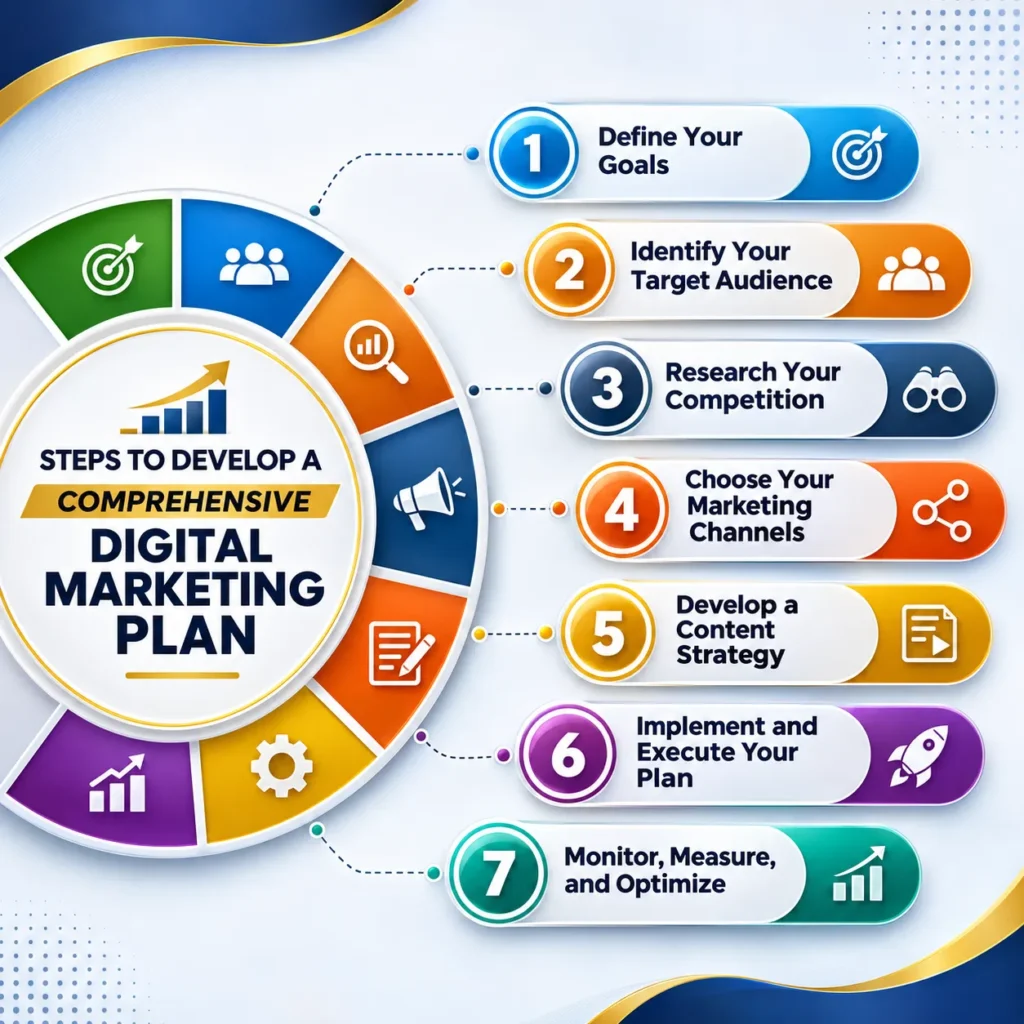
Here is a practical process to follow.
Step 1: Define Your Business Goals
Decide what you want to achieve.
Your goals may include:
- Increasing brand awareness.
- Generating qualified leads.
- Increasing online sales.
- Improving website traffic.
- Getting more local inquiries.
- Retaining existing customers.
Step 2: Identify Your Target Audience
Understand who your potential customers are.
Consider their location, interests, needs, purchasing behaviour and common problems.
A marketing strategy for a local restaurant will be different from one designed for a B2B software company.
Step 3: Build a Professional Website
Your website should clearly explain your business, products, services and contact information.
Focus on:
- Mobile-friendly design.
- Clear navigation.
- Relevant content.
- Fast and reliable performance.
- Strong calls to action.
- Easy contact options.
Step 4: Select the Right Marketing Channels
Choose channels according to your business objectives.
For example:
- SEO for long-term organic visibility.
- Google Ads for relevant search demand.
- Meta Ads for audience reach and lead generation.
- Social media for engagement and brand awareness.
- Email marketing for customer communication.
You do not need to start every channel at once.
Step 5: Create Valuable Content
Publish content that answers customer questions and addresses their problems.
Use blogs, videos, social media posts, guides and other relevant formats.
Content should be helpful and informative rather than purely promotional.
Step 6: Launch and Optimize Campaigns
Once your strategy is ready, launch the selected marketing activities.
Monitor performance and make improvements based on real data.
Step 7: Track Results and Improve
Review your campaign performance regularly.
Identify which channels are bringing relevant visitors, inquiries and customers.
Use these insights to improve your marketing strategy over time.
9. Common Digital Marketing Mistakes to Avoid
Many businesses invest in digital marketing but struggle to achieve their desired results because of avoidable mistakes.
Here are some common problems:
1. Starting Without Clear Goals
Running campaigns without defining the desired outcome makes it difficult to evaluate success.
2. Targeting the Wrong Audience
Reaching people who are unlikely to purchase can waste advertising budget and marketing resources.
3. Ignoring Website Quality
A poorly designed or confusing website may prevent interested visitors from becoming customers.
4. Focusing Only on Likes and Followers
Social media engagement is useful, but businesses should also measure relevant inquiries, sales and customer actions.
5. Expecting Immediate SEO Results
SEO takes time and consistent effort. Businesses should avoid expecting instant organic rankings.
6. Not Tracking Campaign Performance
Without proper measurement, businesses may continue investing in campaigns that are not meeting their objectives.
7. Copying Competitors Without a Strategy
Every business has different customers, products, pricing and positioning. Marketing strategies should reflect those differences.
10. How to Measure Digital Marketing Performance
Digital marketing becomes more effective when businesses understand what is working and what needs improvement.
The right performance indicators depend on your business goals.
| Business Objective | Important Metrics |
| Brand Awareness | Reach, impressions, brand searches |
| Website Traffic | Users, sessions, traffic sources |
| Lead Generation | Leads, CPL, lead quality |
| Online Sales | Transactions, revenue, conversion rate |
| Advertising Performance | CPC, CTR, CPA, ROAS |
| Customer Retention | Repeat purchases, retention rate, email engagement |
For example, a business running a lead generation campaign should not judge success only by the number of leads received.
It should also review lead quality, follow-up rates and the number of leads that eventually become paying customers.
11. When Should a Business Start Digital Marketing?
The right time to start digital marketing depends on your business readiness and objectives.
However, businesses should begin building their online presence as early as practical.
A startup may initially focus on a professional website and social media presence. A local shop may prioritize Google Business Profile and local SEO. An established company may need a combination of organic marketing, paid campaigns and customer retention activities.
You do not need a massive budget to begin.
Start with a clear business objective, understand your audience, select suitable channels and improve your strategy based on results.
The most important thing is to build a consistent and relevant online presence.
12. Frequently Asked Questions (FAQs)
Q1. Why is digital marketing important for every business?
Digital marketing helps businesses improve online visibility, reach relevant audiences, communicate with customers, generate leads and measure marketing performance. It provides opportunities for businesses of different sizes and industries to connect with potential customers.
Q2. Is digital marketing necessary for small businesses?
Yes. Small businesses can use digital marketing to improve local visibility, showcase products and services, connect with nearby customers and compete within specific market segments.
Q3. How does digital marketing help businesses grow?
Digital marketing can support business growth through brand awareness, website traffic, lead generation, customer engagement and online sales. Results depend on the strategy, audience, competition and execution.
Q4. Which digital marketing channel is best for a business?
There is no single best channel for every business. SEO is useful for organic search visibility, Google Ads for search-driven demand, Meta Ads for audience targeting and social media marketing for engagement and brand building. The right combination depends on business goals.
Q5. Is digital marketing expensive?
Digital marketing budgets can vary depending on the channels, competition, audience and business objectives. Businesses can begin with selected activities and increase investment as they understand their marketing performance.
Q6. How long does digital marketing take to show results?
Paid advertising can start generating traffic or inquiries soon after a campaign launches, although results are not guaranteed. SEO and organic content strategies generally require sustained effort and may take several months to show meaningful progress.
Q7. Can digital marketing increase sales?
Digital marketing can help businesses attract potential customers and create opportunities for sales. However, actual sales also depend on product quality, pricing, customer experience, sales processes and market demand.
Q8. Why does a business need a digital marketing agency?
A digital marketing agency can help businesses with strategy, content creation, SEO, advertising, campaign management and performance analysis. It can be useful for companies that lack the time or in-house expertise to manage these activities.
13. Conclusion: Digital Marketing Is an Important Part of Modern Business Growth
Digital marketing has become an important part of how businesses build visibility, communicate with customers and promote their products and services.
From improving search engine visibility and building brand awareness to generating leads and supporting customer retention, digital marketing offers several opportunities for businesses across different industries.
However, success does not come from simply creating social media accounts or running advertisements. It requires a clear strategy, a good understanding of customers, valuable content, suitable marketing channels and consistent performance analysis.
Whether you are starting a new business or trying to grow an established company, building a strong digital presence can help you create more opportunities to connect with your target audience.
Ready to Grow Your Business Online?
At EVGROW Marketing, we help businesses build and improve their digital presence through SEO, social media marketing, Google Ads, Meta Ads, content marketing and lead generation strategies.
Whether you want to increase brand awareness, attract potential customers or improve your online visibility, our team can help you identify a suitable digital marketing approach based on your business goals.
Let’s discuss how digital marketing can support your business growth.
Visit: https://evgrow.in/digital-marketing-services/
Contact EVGROW Marketing and take the next step towards building a stronger online presence.
What do you think?
Which digital marketing channel is most important for your business—SEO, Google Ads, Meta Ads or Social Media Marketing?
Share your thoughts and questions with us.
If you found this article useful, share it with other business owners who want to grow their businesses online.